
Designing Multi-Level Vertical Territories for Confident Indoor Living
Rethinking Verticality in the Modern Indoor Cat Home
A conventional cat tree can provide a scratching post, a platform, and a soft bed, yet it may solve only a fraction of the spatial problem in a multi-cat home. When several cats are expected to share one isolated tower, the most confident individual may occupy the preferred level while a more cautious companion avoids the structure altogether. The result is not true enrichment, but a territorial bottleneck disguised as furniture. A carefully planned multi-level cat tower can be useful, but its greatest value appears when it forms part of a larger architectural system.
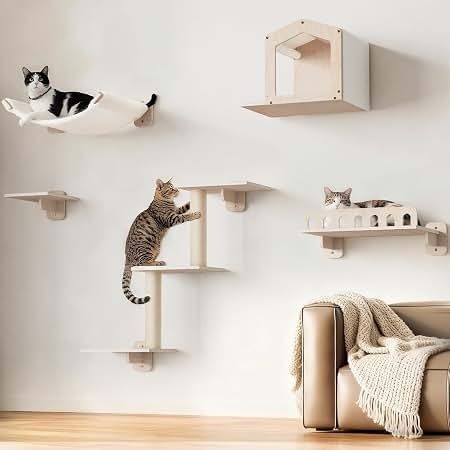
For cats, height is not merely a decorative feature or a convenient place to nap. Elevated territory supports observation, retreat, movement, and choice. A cat that can travel above human foot traffic, pass around another cat, and settle in a sheltered position gains control over social encounters. By extending routes along walls, shelving, furniture perimeters, and carefully anchored platforms, you effectively increase the functional square footage of the home without changing its floor plan. The objective is a calm domestic landscape in which every cat can move, pause, watch, and withdraw without being forced into a confrontation.
The Feline Highway and the Principle of Continuous Flow
A successful vertical layout behaves like a highway rather than a series of disconnected islands. The route may begin at a stable floor tower, rise to a shelf, continue across a bridge, and descend near another useful area. Along the way, cats should encounter broad resting platforms, scratching surfaces, and alternative directions. Wall lines and furniture perimeters are particularly effective because they allow cats to move through a room while remaining close to boundaries, a pattern that often feels more secure than crossing an exposed open floor.
Dead ends deserve special attention. A shelf that terminates against a wall, a high perch with only one narrow approach, or a hideaway with a single entrance can become a trap when another cat blocks the exit. The psychological consequence may be considerable: the approached cat has no graceful way to disengage, while the approaching cat learns that the pathway is an excellent place to control access. Repeated incidents can produce avoidance, vigilance, hissing, chasing, or stress-related marking. A route with multiple choices is kinder because it allows a cat to retreat before tension escalates.
Environmental complexity should not be confused with clutter. The most effective designs are legible and deliberate, with an obvious progression between levels and enough width for a cat to turn comfortably. Research on feline environmental needs, supported by this Authoritative Source, emphasizes the importance of choice, control, and opportunities for natural behavior. A review of feline enrichment literature, such as the peer-reviewed AAFP and ISFM Feline Environmental Needs Guidelines, helps explain why varied, complex environments can support behavioral wellbeing and reduce the effects of social stress.
- Provide at least two practical directions at important junctions, especially near sleeping areas and room entrances.
- Avoid placing a high-value bed at the end of a narrow passage where another cat can guard the approach.
- Use bridges, staggered shelves, and furniture connections to create loops rather than single linear climbs.
- Keep escape options visible and usable, with no curtain, cabinet door, or decorative object obstructing the route.
- Inspect each junction from the cat”s perspective, asking whether a retreat remains possible if another cat occupies the nearest platform.
Ergonomic Dimensions and Structural Safety for Secure Climbing
Dimensions should reflect the cat”s age, body size, mobility, and confidence. A young athletic cat may manage a larger vertical rise, but an older cat, a heavy-bodied breed, or an animal recovering from discomfort benefits from shorter, more predictable transitions. A practical planning range is 12 to 18 inches between shelves for cautious or senior cats, with rises up to approximately 24 inches reserved for agile individuals. Horizontal gaps should generally remain below 24 inches, and every landing should be large enough for a cat to turn, crouch, and launch without balancing on an edge.
Surface texture is equally important. High-grip sisal is valuable for scratching and controlled traction, while felt runners can soften a hardwood shelf and reduce sliding during a quick turn. Treated hardwood may offer a refined appearance, but it should have a stable, non-glossy finish and no splinters or exposed fasteners. Structural safety must be planned for movement, not merely for a resting cat. Jumping and landing create dynamic forces, so supports require generous margins, secure brackets, and attachment to suitable framing wherever possible. Drywall, plaster, brick, and masonry each require compatible anchors; a fastener chosen without identifying the wall type is not a reliable safety plan.
| Design element | Recommended reference | Reason for the guideline |
|---|---|---|
| Vertical rise | 12 to 18 inches for older or cautious cats | Supports controlled climbing and reduces demanding jumps |
| Maximum rise for athletic cats | Up to approximately 24 inches | Allows larger transitions when the cat is fit and confident |
| Horizontal gap | Under 24 inches | Limits awkward leaps and preserves route continuity |
| Landing surface | Broad enough to turn and launch securely | Reduces edge balancing and hesitant movement |
| Mounting capacity | At least 50 pounds per mounting point as a planning margin | Accounts for jumping forces, not only static body weight |
| Surface finish | High-grip sisal, felt, or stable treated wood | Improves traction and reduces slipping |
Sightlines, Perch Placements, and Social Hierarchy
Not every elevated location serves the same behavioral purpose. A surveillance perch should offer a broad view of the room, windows, doors, or household activity. It may be open, firm, and positioned at a height that allows the cat to monitor movement without being touched. A restorative sleep nook has a different character: it should feel sheltered, quiet, and preferably equipped with more than one way to leave. Confusing these functions can leave a cat with plenty of visibility but nowhere to rest undisturbed.
Vertical distribution can also soften competition around essential resources. If food, water, litter boxes, and resting places are concentrated in one area, a socially assertive cat may control access without obvious fighting. Other cats may simply wait, avoid the area, or use resources at inconvenient times. Additional elevated routes do not replace appropriately distributed resources, but they can provide alternative approaches and resting points. For guidance on why elevated resting areas matter in an indoor feline environment, consult the Ohio State University resource on cat perches.
Height variation is preferable to creating one supreme throne. Place one perch where a cat can observe the room, another behind a partial visual screen, and a lower platform near a familiar piece of furniture. This allows cats to occupy the same room without being forced into direct eye contact. Temperament matters as much as body size: a shy cat may prefer a medium-height retreat with concealment, while a confident cat may select an open upper platform. Observe which routes each cat chooses, and adjust bedding, scent objects, or access points rather than assuming every individual wants the highest position.
- Separate open lookout points from quiet sleeping niches.
- Offer more than one elevated resting place in rooms shared by multiple cats.
- Use staggered heights so cats can avoid direct face-to-face encounters.
- Keep litter boxes and feeding stations accessible without requiring passage through a single contested route.
- Watch for prolonged staring, blocking, crouching, or sudden route avoidance, all of which may indicate that a pathway needs redesign.
Step-by-Step Execution of an Integrated Room Blueprint
Begin with observation rather than drilling. Note where cats already travel, where they hesitate, which doorways create congestion, and where natural light encourages resting. Mark the proposed route with painter”s tape, including the first reachable platform, every turn, each bridge connection, and the intended descent. A good plan links existing furniture to new structures while preserving human circulation. Freestanding towers should be stable and, where appropriate, anchored; floating ledges should never be treated as decorative items that happen to carry a moving animal.
- Map high-traffic floor zones, doorways, feeding areas, litter areas, and preferred resting spots.
- Identify entry and exit hubs, then design a route that begins at floor level or an accessible piece of furniture.
- Connect a stable tower to shelves, bridges, and ledges, maintaining manageable rises and at least one alternate direction at key points.
- Confirm the wall material, locate studs or suitable masonry attachment points, and select hardware rated for dynamic loading.
- Install one section at a time, checking level, rigidity, surface grip, and clearance after every addition.
- Introduce the structure gradually with treats, play, familiar bedding, and scent transfer rather than lifting a reluctant cat onto a high shelf.
Positive reinforcement is especially important when a new route changes the visual character of a room. Place a familiar blanket on a low platform first, reward investigation, and allow each cat to decide the pace of exploration. Scent transfer can make a new surface less foreign, while interactive play can demonstrate that the route leads to desirable experiences. Never force a nervous cat upward. Confidence develops when the animal retains control over approach, pause, and retreat.
Transform Your Walls Into Pathways of Feline Confidence
Thoughtful vertical territory turns overlooked wall space into a functioning domestic ecosystem. The value lies not in the number of shelves or the height of the tower, but in the relationships between them. A well-engineered route offers traction, visibility, shelter, and choice. It lets one cat pass above a busy floor while another rests behind a screen, and it reduces the likelihood that a single doorway, bed, or tower will become the center of every disagreement.
Over time, improved access to climbing, observation, retreat, and play can support daily activity and emotional security. Reduced competition may also lessen behaviors associated with territorial strain, including avoidance and urine marking, although medical causes and behavioral concerns always warrant veterinary guidance. Assess the room carefully, begin with one continuous section, and evaluate how each cat uses it. When vertical design is built around feline movement rather than human decoration alone, the home becomes quieter, more generous, and far more confident underfoot and overhead.